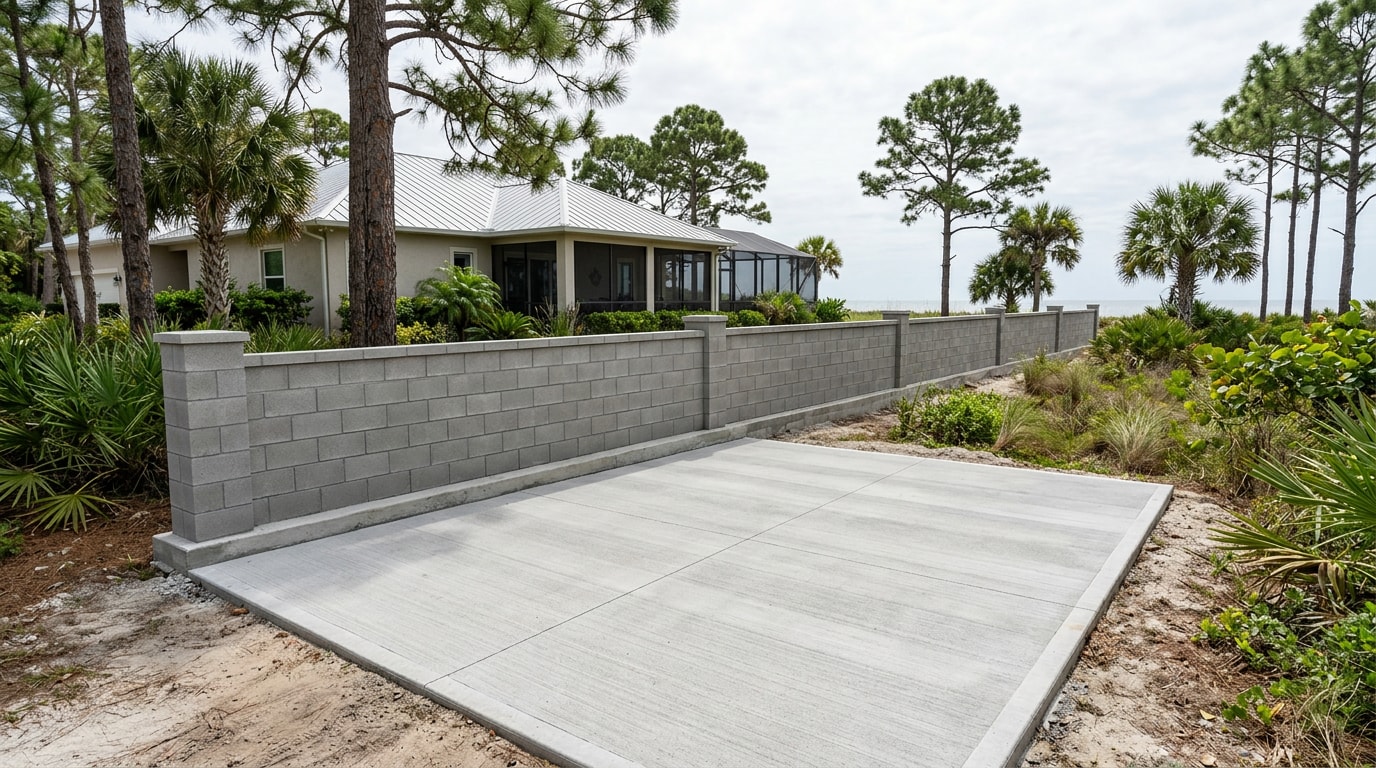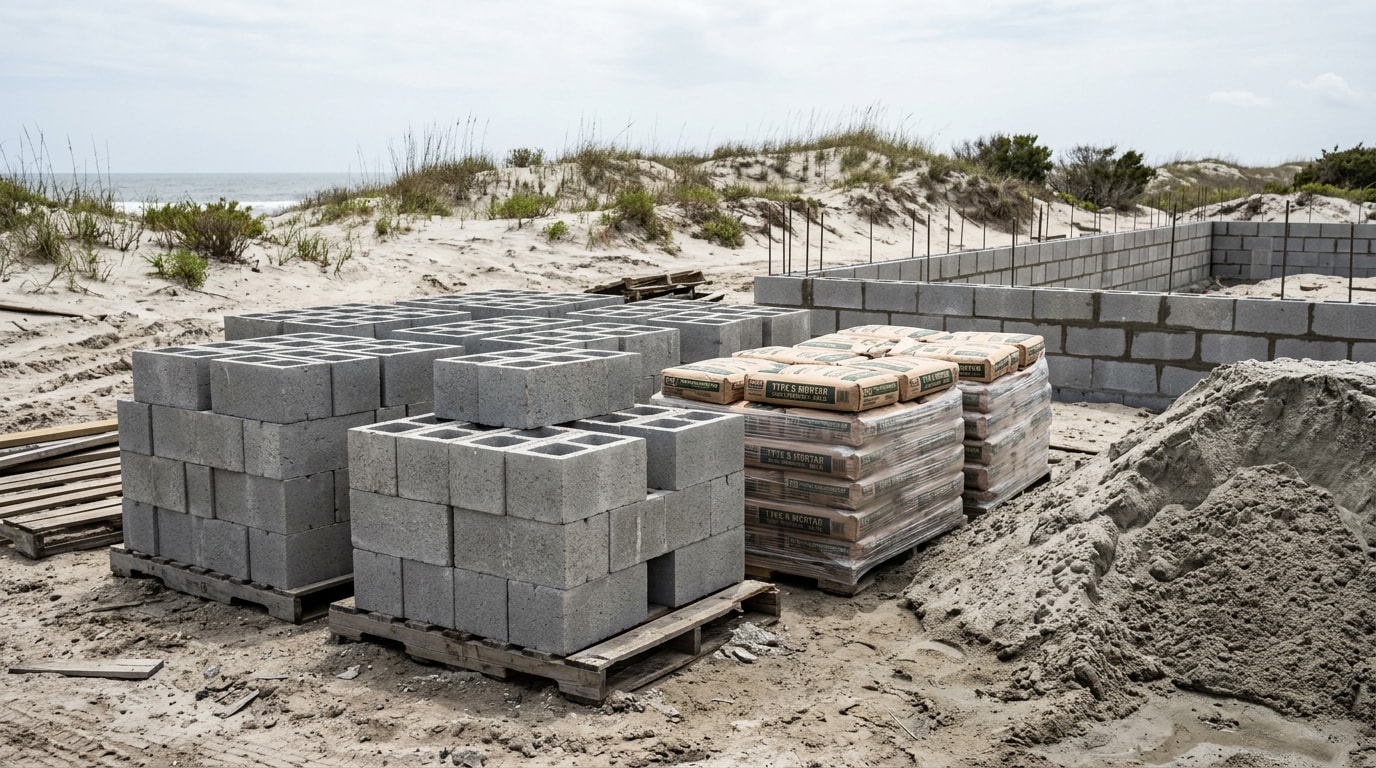
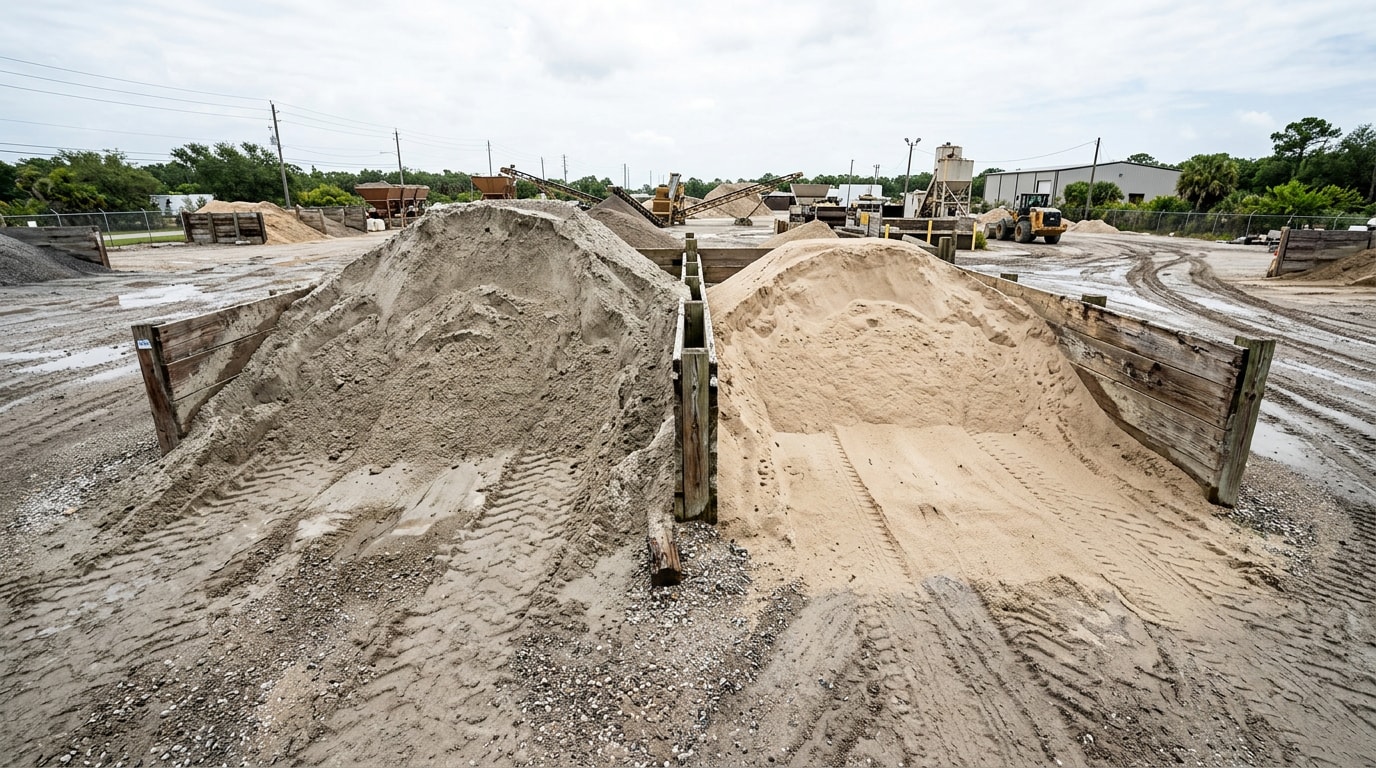
The masonry sand vs concrete sand decision in Navarre, FL comes down to three things: grain size, grain shape, and the ASTM spec the pile was produced to. Both bins sit a few feet apart at every yard on the Panhandle and both look like tan dry sand from the cab of a truck. Order the wrong one and you either fight the trowel all day or pull the pavers back up next summer.
Quick Answer: Which Sand for Which Job
| Your project | Order this | Spec to ask for |
|---|---|---|
| Brick, block, or stone mortar | Masonry sand | ASTM C144 |
| Stucco scratch and brown coat | Masonry sand | ASTM C144 |
| Paver joint sweep | Masonry sand or manufactured joint sand | ASTM C144 |
| Paver bedding course | Concrete sand | ASTM C33, washed |
| Slabs, footings, driveways | Concrete sand | ASTM C33 |
| Pipe bedding and drainage fill | Concrete sand | ASTM C33 |
If a plan set or engineer names a material, do not substitute without written approval from whoever wrote the spec.
What Is Concrete Sand?
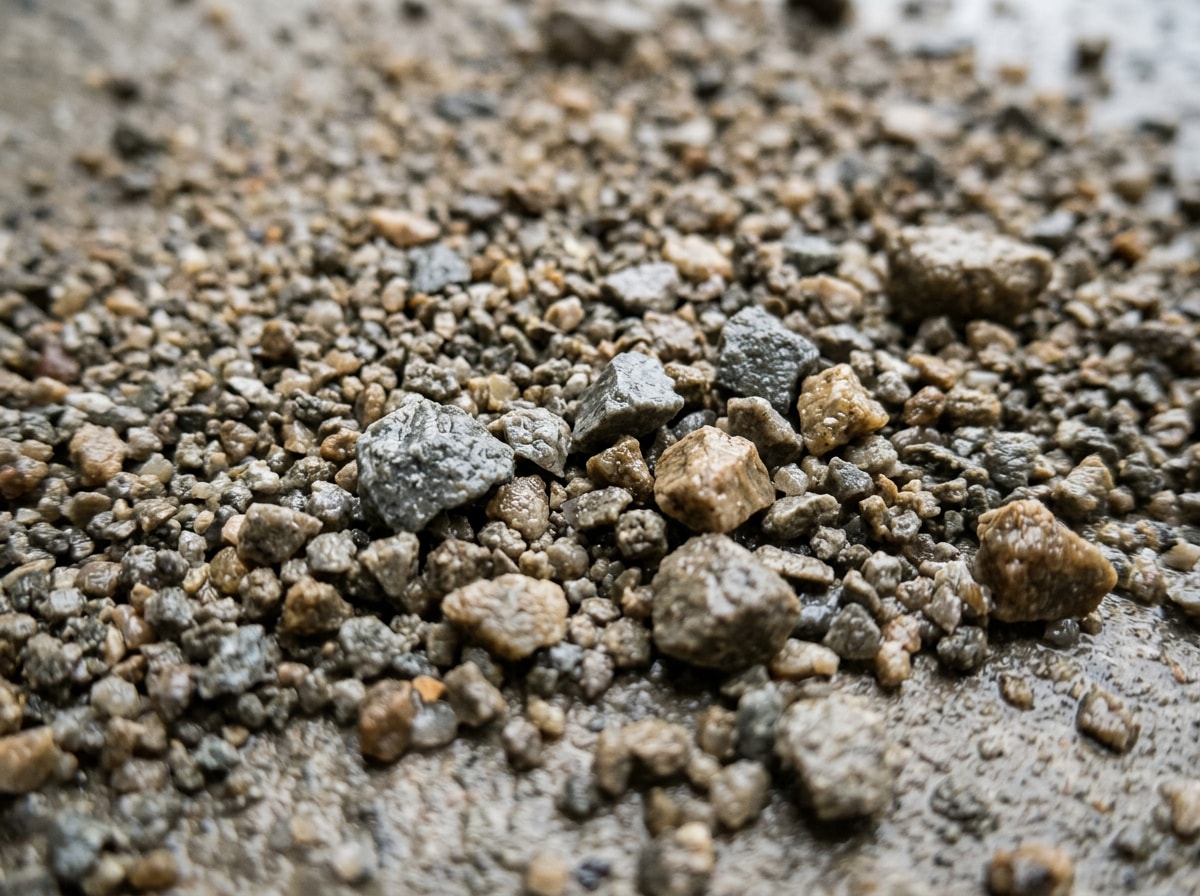
Concrete sand is the coarsest of the washed sands. It is usually crushed from harder source rock like granite or limestone, then washed and screened to strip out silt and clay.
Its angular grains lock against each other inside cement paste. That interlock is a large part of what gives a mix its compressive strength.
Where it shows up on a job:
- Ready mix and structural concrete
- Paver bedding layers
- Pipe bedding and backfill
- Drainage fill and French drains
Some yards label it sharp sand or just washed sand, so ask what the bin actually holds before you load.
What Is Masonry Sand?
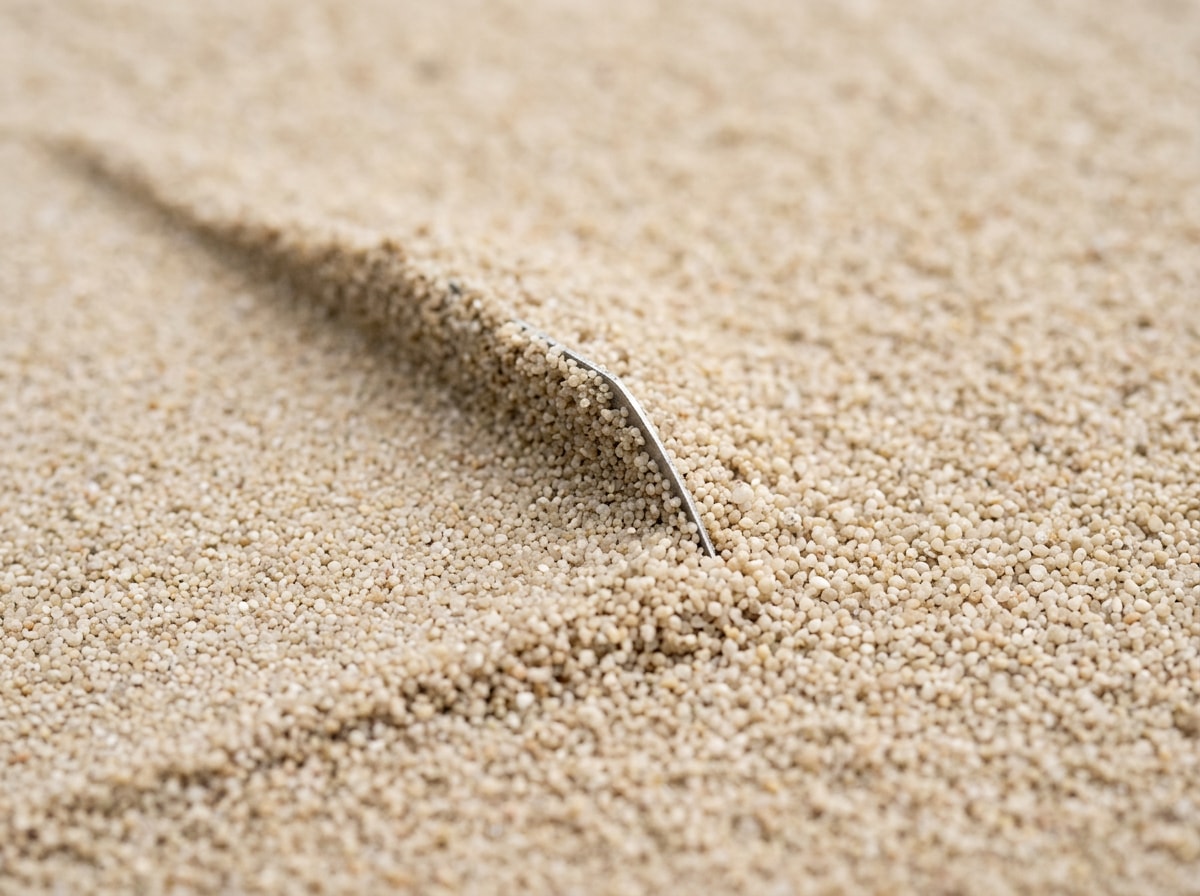
Masonry sand is the finer, more heavily screened washed sand. Most of its particles fall between the #30 and #100 sieve sizes , and that tight band is exactly what makes mortar spread, hold water, and tool cleanly.
You will hear it called mason sand, mortar sand, brick sand, or plaster sand depending on who writes the ticket. Navarre suppliers are not consistent about naming, so confirm by spec, not by label.
Common uses:
- Mortar for brick, block, and stone veneer
- Stucco and plaster
- Joint sweep between pavers
- Pool bases, volleyball courts, and arena footing
One caveat worth stating plainly: masonry sand is washed for construction cleanliness, not to play sand safety standards. It is cleaned for construction purposes but is not processed to the same safety standards as play sand , so it is not a sandbox material.
The Measurable Differences
Particle Size
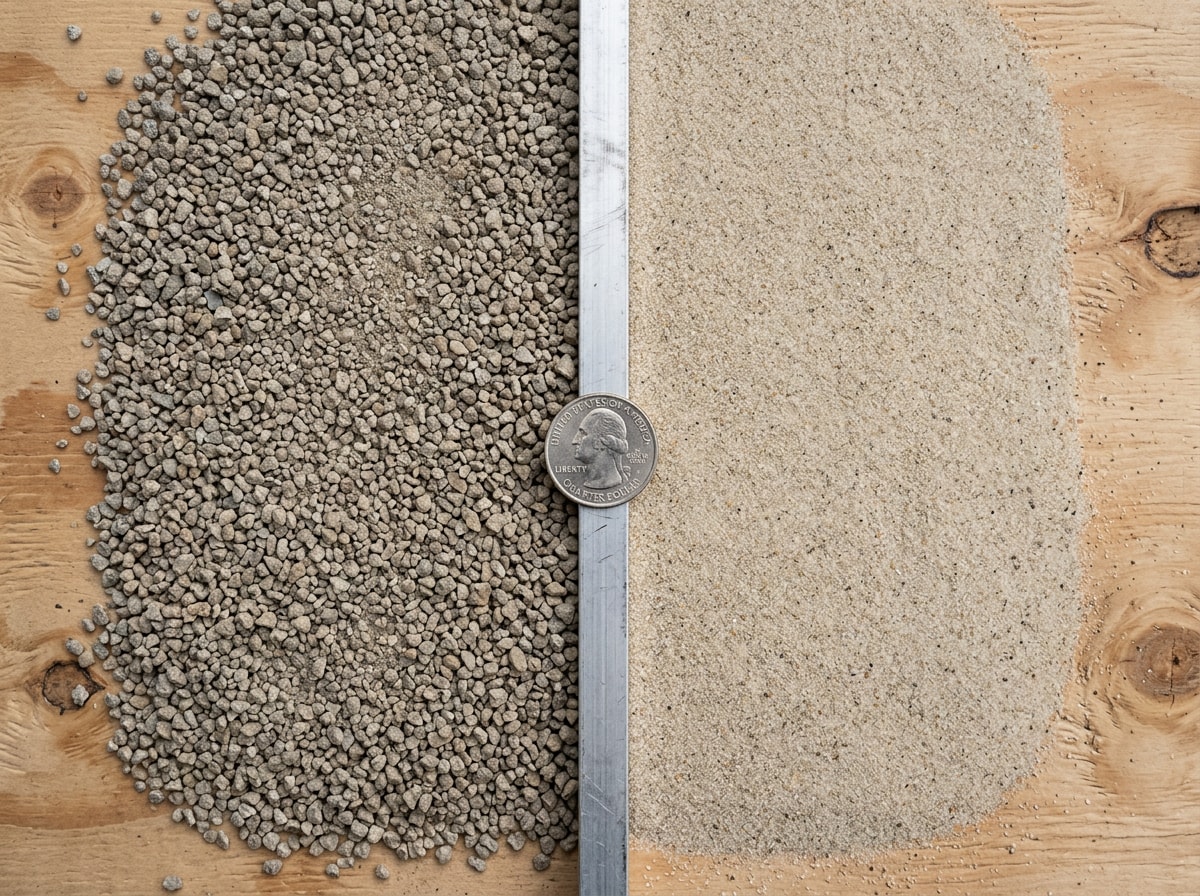
Concrete sand runs roughly 0.2 to 4.0 mm and grades up toward the 3/8 inch sieve. Masonry sand is much finer, with grains generally ranging from about 0.075 mm to 2 mm .
That gap is the clearest way to separate the two on a gradation report.
The consequence is simple. A broad size spread gives you aggregate interlock and strength in a structural mix. A narrow, fine band lets mortar fill a 3/8 inch bed joint completely without leaving voids.
Grain Shape and the Handful Test
Concrete sand grains are angular in shape, while masonry sand grains are rounded. Angular grains build mechanical bond in concrete. Rounded, uniform grains build workability in mortar.
There is a field test that needs no spec sheet. Grab a handful at the yard.
- Concrete sand catches on your palm and leaves grit behind.
- Masonry sand pours off your hand almost like flour.
Run that test before the loader swings, not after the truck dumps.
ASTM C33 vs ASTM C144 Gradation
The real dividing line is not the bin label. It is the specification the sand was produced to.
Concrete sand is graded to ASTM C33, the standard for concrete aggregates. Masonry sand is graded to ASTM C144, the specification for aggregate for masonry mortar, which covers aggregate for masonry mortar, allows natural or manufactured sand, and requires grading within prescribed limits .
Here are the two bands side by side as approximate percent passing. Confirm against the current published edition before writing a submittal.
| Sieve | ASTM C33 (concrete sand) | ASTM C144 (natural masonry sand) |
|---|---|---|
| 3/8 in. | 100 | not specified |
| No. 4 | 95 to 100 | 100 |
| No. 8 | 80 to 100 | 95 to 100 |
| No. 16 | 50 to 85 | 70 to 100 |
| No. 30 | 25 to 60 | 40 to 75 |
| No. 50 | 5 to 30 | 10 to 35 |
| No. 100 | 0 to 10 | 2 to 15 |
In plain English: by the No. 16 sieve, most masonry sand has already passed through while a large share of concrete sand has not.
Ask your supplier for a gradation report that names C33 or C144. If the yard cannot produce one, you are buying by color and feel.
Which Sand for Paver Bedding in Navarre?
This is the one application where homeowners and installers still argue, so here is the industry answer with the data behind it.
The Concrete Masonry and Hardscapes Association, which absorbed ICPI, is direct about it. Bedding sand should conform to the grading requirements of ASTM C33, and mason sand should not be used because it can be slow draining and unstable.
The sand should be screeded to a consistent 1 to 1.5 inch uncompacted thickness.
The number most articles leave out is permeability. In CMHA Tech Note PAV-TEC-017 on bedding sand selection, typical specifications call for C33 gradation with an added limit of 1 percent passing the No. 200 sieve , and measured permeability of bedding sands rated very good to excellent ranged from 2.8 to 15.6 inches per hour, corresponding to fines between 2.5 percent and 0 percent passing that sieve .
That matters more here than almost anywhere else in the country. Navarre sits on a high water table with heavy summer rainfall, and a bedding course that drains at the low end of that range holds water under your pavers every afternoon in August.
Every washed out paver patio we have torn out along the 98 corridor had the same two things underneath: fine mortar sand and a base that never got compacted. The fines migrate, the screed course thins in spots, and the field goes wavy in a season or two.
Joint sand and bedding sand are separate jobs with separate materials. Use C33 under the pavers and a fine sweep sand in the joints.
Planning a new install? See our paver patio installation) and paver driveway installation) pages, or get a free estimate and we will spec the base and bedding for your soil.
Which Sand for Mortar
Masonry sand graded to C144, every time. That covers brick, block, stone veneer, chimney repair, and stucco scratch and brown coats.
Substitute concrete sand and you get a gritty mix that fights the trowel. The coarse particles will not fill a standard 3/8 inch bed joint completely, which leaves voids, reduces bond strength between unit and mortar, and produces a pitted joint face no amount of tooling will clean up.
On brick and block masonry that is a finish problem and a durability problem at the same time. Our full masonry contractor lineup runs C144 sand on every mortar joint we place.
Which Sand for Slabs and Footings
Concrete sand graded to C33, for slabs, footings, sidewalks, driveways, and any load bearing mix.
Swapping in masonry sand hurts the pour twice over. Uniform fine gradation carries more surface area per pound, which raises water demand and pushes up the water to cement ratio. At the same time you lose aggregate interlock. Lower compressive strength and more shrinkage cracking follow.
That is why we hold the C33 line on concrete foundation and footer installation and concrete driveway installation alike.
For any public, county, or state funded job in Santa Rosa County, certified material graded to the FDOT Standard Specifications for Road and Bridge Construction is the governing requirement. Those specifications set the requirements for the method of performing work and the quantities and qualities of materials on all FDOT contracts. Verify the applicable section number before you submit.
Ordering Sand in Navarre: Tonnage and Delivery
Volume math beats guesswork. One cubic yard is 27 cubic feet, and sand runs roughly 1.3 to 1.4 tons per cubic yard depending on moisture.
| Depth | Coverage per cubic yard | Approx. tons per 100 sq ft |
|---|---|---|
| 1 in. | about 324 sq ft | about 0.4 |
| 1.5 in. | about 216 sq ft | about 0.6 |
| 2 in. | about 162 sq ft | about 0.8 |
Add 5 to 10 percent for screed waste and compaction. Damp sand also weighs more per yard than the stockpile looks like it should, so buy by volume and confirm the conversion on the ticket.
Two local ordering notes:
- Delivery distance from the pit usually moves your total more than the price difference between the two sands.
- Cover the pile. Panhandle afternoon storms will wash fines out of an uncovered stockpile and change your gradation before you ever use it.
If you are sourcing block, mortar, sand, and stone for the same job, our guide to concrete and masonry supply delivered on the Panhandle walks through what to order together.
Work With Us
Gulf Breeze Concrete Services builds flatwork, masonry, and hardscape across Navarre, Gulf Breeze, and Pensacola. Our crews spec sand by gradation report, not by bin label, on every pour and every mortar joint.
See recent work on our projects page, browse services from the homepage, or request a free estimate and tell us what you are building. We will tell you exactly which sand to put on the ticket.
FAQ
Can I use masonry sand instead of concrete sand?
Not for structural concrete. It is too fine, raises water demand, and weakens the finished mix. The exception is light duty, non structural work or a fine finish coat where strength is not the governing factor.
Can I use concrete sand as bedding material for pavers?
Yes, and it is the recommended material. Washed, well graded concrete sand drains and transfers load better than mason sand. Screed it 1 to 1.5 inches uncompacted over a compacted dense graded base.
Can I mix concrete sand and masonry sand together?
Not recommended. Blending the two produces an unpredictable gradation that satisfies neither C33 nor C144, so you give up the performance both specs exist to guarantee.
Is concrete sand more expensive than masonry sand?
It varies by yard. Masonry sand often carries a small processing premium for the extra screening, but haul distance from the pit usually outweighs the material difference. Ask for current per ton pricing delivered to your Navarre address.
What is masonry sand used for besides mortar?
Stucco and plaster, paver joint sweep, pool bases, volleyball courts, and arena footing. Anywhere a fine, uniform, easily screeded surface matters more than load transfer.
Is mason sand the same as play sand?
No. Mason sand is washed to construction cleanliness standards, not to the safety standards play sand is processed to. Buy sand labeled for play areas instead.
Can you make concrete with mason sand?
You can mix it, but you should not use it for anything structural. Expect higher water demand, lower compressive strength, and more shrinkage cracking than a C33 mix.
How much sand do I need for a paver patio?
Take your square footage and divide by 216 for a 1.5 inch bedding course, which gives you cubic yards. Add about 10 percent for waste. A 400 square foot patio needs roughly 2 cubic yards of C33 bedding sand.
Does sand type matter more in Florida than elsewhere?
For bedding and drainage, yes. High water table and heavy rainfall punish any bedding course that holds water, which is why the slower draining fine sand fails faster here than in drier climates.