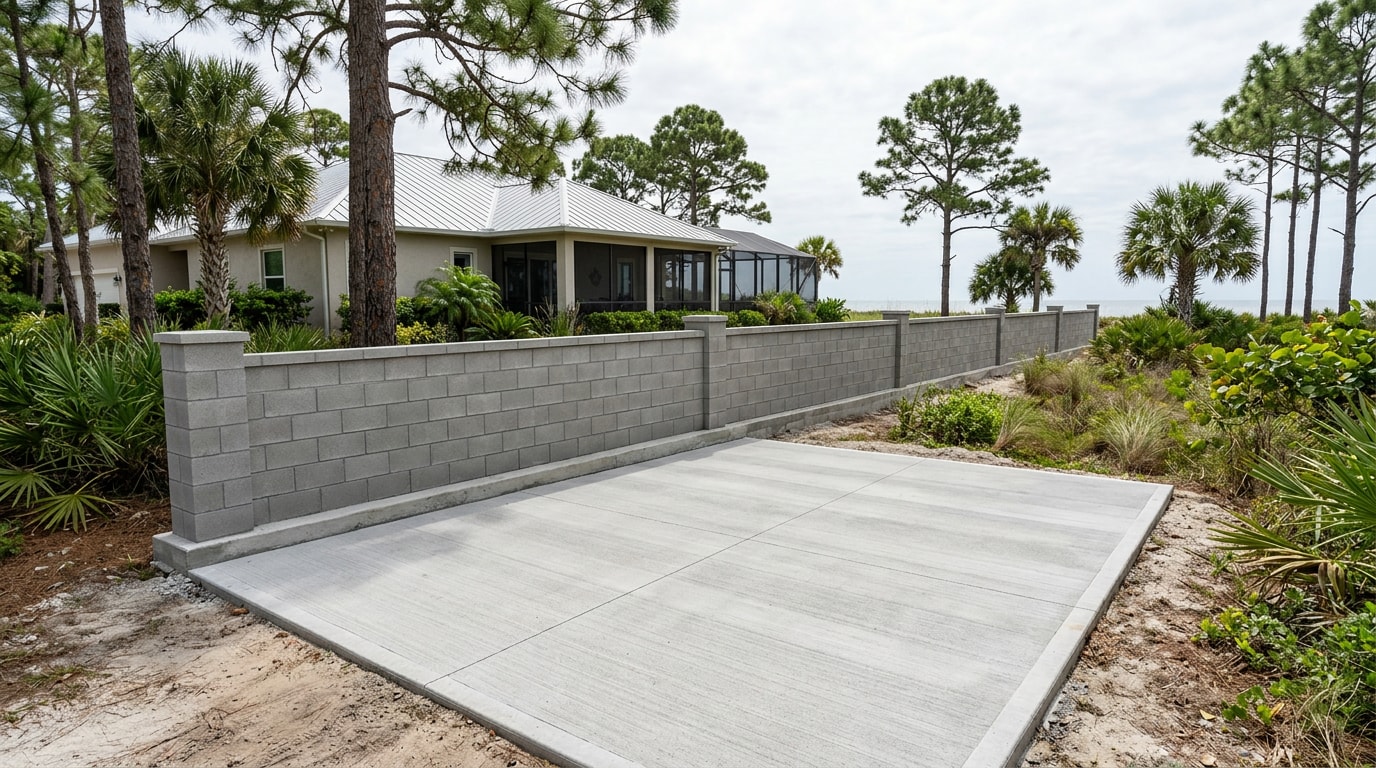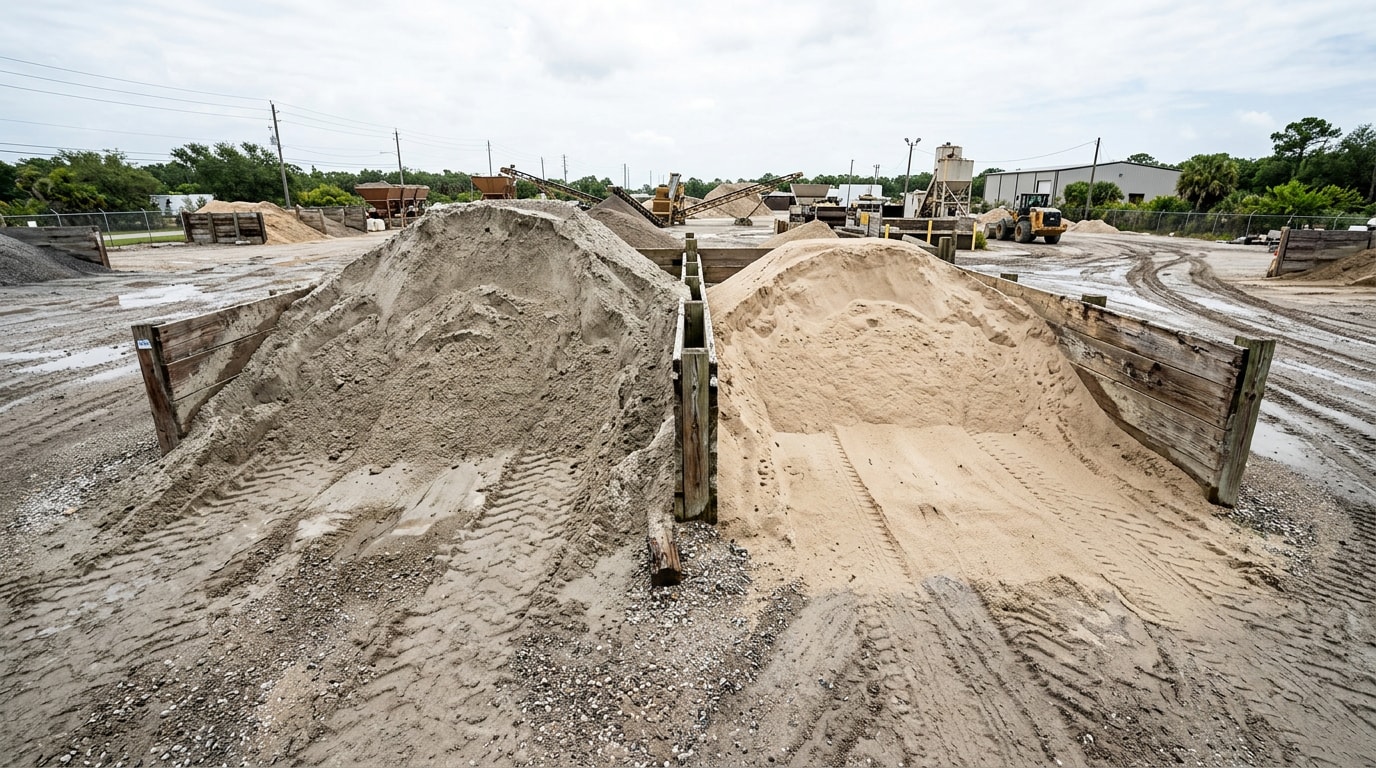
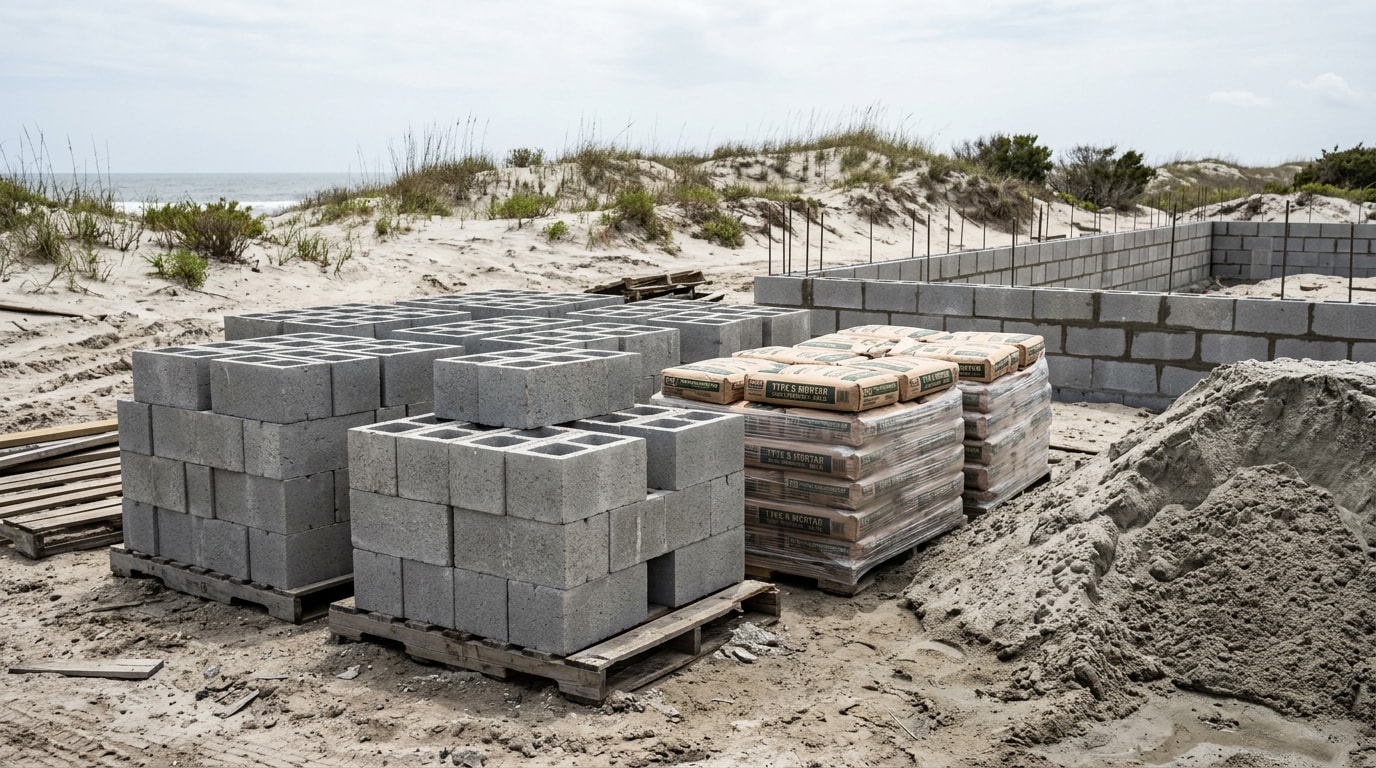
Concrete masonry supply in Pensacola Beach, FL comes down to four line items: block, the mortar and grout that bind it, graded sand, and the crushed stone base underneath. Almost none of it is bought over a counter here, because 32561 is a barrier-island ZIP served by mainland yards across a bridge. That one geographic fact decides your truck size, your lead time, and how much of your budget disappears into freight.
What Concrete Masonry Supply Covers on Pensacola Beach
Most island orders are a package, not a single product. Here is the short version of what goes on the ticket and how it is sold.
| Material | What it does | How it is usually sold |
|---|---|---|
| CMU (8x8x16, 12x8x16) | Stem walls, foundations, partitions | Per block, or by the pallet |
| Specialty block (lintel, column, half, cap) | Openings, piers, coursing, wall tops | Per piece |
| Mortar and mason mix | Bonds units | 60 to 80 lb bags |
| Coarse grout | Fills reinforced cells around rebar | Bags, or ready-mix by the yard |
| Mason sand | Mortar, paver bedding, leveling | By the cubic yard or ton |
| Concrete sand | Structural mixes, mortar sand | By the cubic yard or ton |
| #57 stone | Footing drainage, slab base, concrete | By the ton |
| Crusher run / road base | Compacted base under drives and slabs | By the ton |
Two buyers drive the volume: the homeowner capping a seawall, rebuilding a driveway or setting a paver base, and the contractor staging materials for a coastal build.
If you are pricing the labor side too, our masonry contractor services and Pensacola Beach service area page cover what we build on the island.
Where to Buy: Mainland Yard, Delivered Load, or Contractor Supplied
You have three realistic options on Santa Rosa Island.
- Pick up at a mainland yard. Cheapest per unit. Practical only for bagged goods and a few pallets, and a half ton of sand in a pickup bed is already at the axle limit of most half-tons.
- Bulk delivery to 32561. The default for anything over a ton. Barrier-island addresses are commonly priced as their own delivery zone rather than sitting inside a mainland free-delivery radius, so confirm the zone charge before you compare per-ton prices.
- Contractor supplied. On permitted structural work, the crew doing the pour usually buys the block, grout and base stone as part of the job, which removes the storage and re-handling problem on a narrow lot.
On beachfront lots we have staged material for, stock at the yard is almost never the constraint. The constraint is whether a loaded truck can turn around without dropping a wheel into soft shoulder sand.
Concrete Block: Standard Sizes and Specialty Shapes
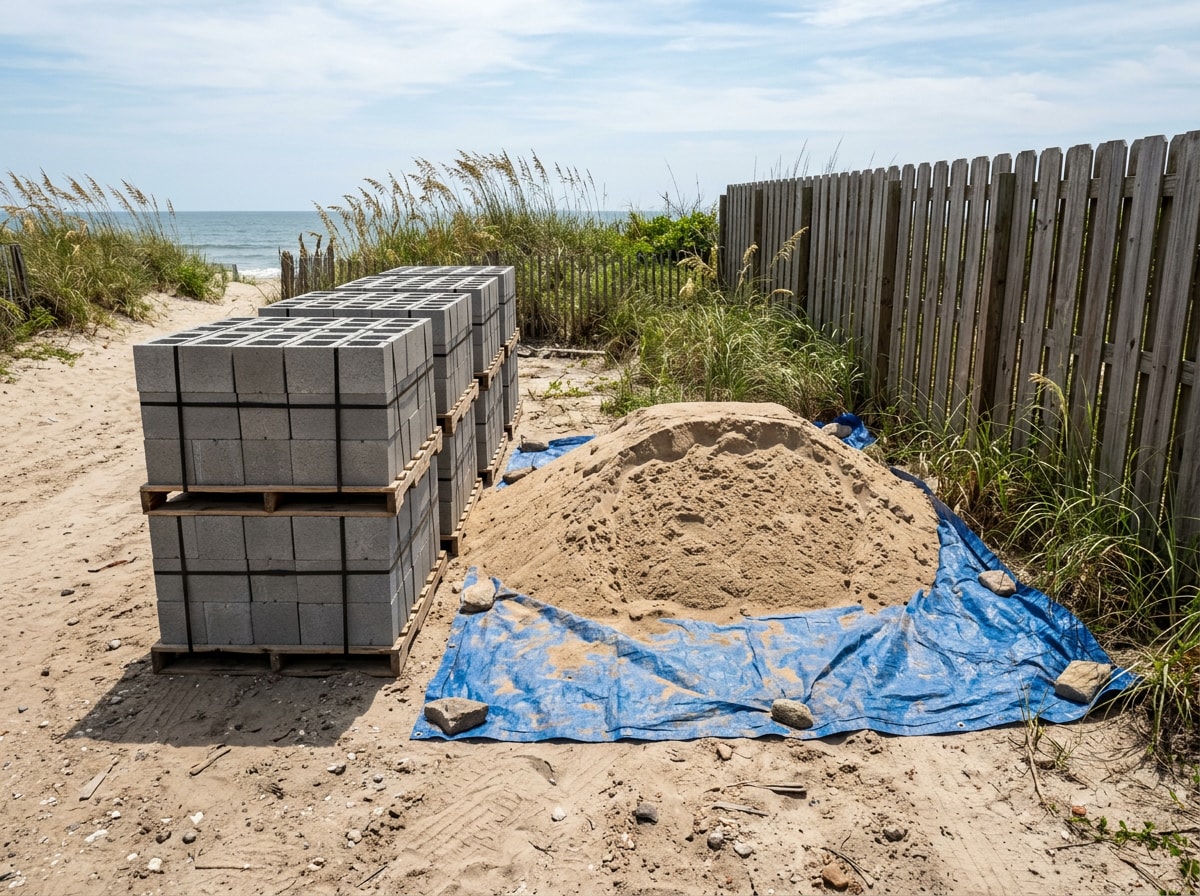
Concrete masonry units are the structural spine of most orders, covering load-bearing stem walls, foundations and non-load-bearing partitions.
Specialty Blocks: Lintel, Column, Louver and Split-Face
Beyond standard 8x8x16 and 12x8x16 CMU, coastal jobs need shapes:
- Lintel and U-lintel block carry openings over doors and windows and hold rebar and grout.
- Column block, commonly 12x12, forms grouted piers and porch columns.
- Louver or vent block ventilates crawl and utility spaces.
- Split-face block gives a finished texture where a wall stays exposed.
- Half blocks keep coursing clean at corners.
- Wall caps close the top of a fence or seawall.
Lightweight and normal-weight units are both common. Lightweight lays faster, which matters when a crew has one dry day. Pallet counts vary by producer, so confirm the count before you calculate freight.
That product line feeds straight into brick and block masonry and retaining wall construction work.
Cement, Mortar, Grout and Mix
Block never ships alone. Portland cement, bagged mason mix, mortar mix, coarse grout, pump mix, fast-setting mix and high-strength structural mix all pair with it.
Mortar choice comes down to load and exposure. Type S is the usual pick for load-bearing and below-grade coastal walls because of its higher bond and compressive strength. Type N generally suits above-grade veneer and softer units. Grout, not mortar, fills reinforced cells around rebar.
Units and mortars are governed by published specifications. The Concrete Masonry and Hardscapes Association technical note on unit shapes, sizes and specifications explains what ASTM C90 requires of load-bearing units, and C270 does the same for mortar.
If you are mixing on site rather than ordering ready-mix, our guide to concrete mixers and masonry on Pensacola Beach covers sizes and when renting stops making sense.
Sand, Gravel and Crushed Stone
Block and mortar are half an order. Base stone, backfill and sand carry the rest. Angular stone handles structure and drainage. Sand handles mortar, bedding and fill.
Gravel and Crushed Stone
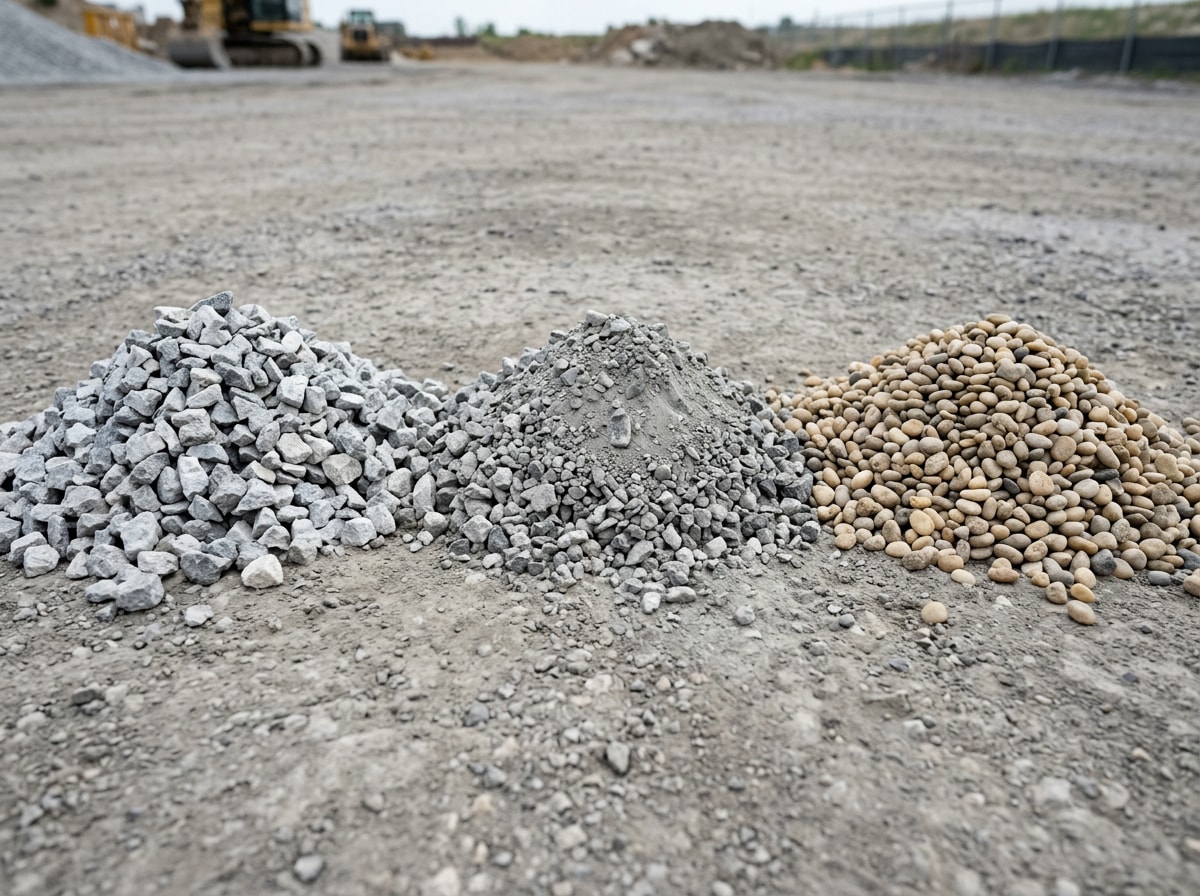
- #57 stone (¾ inch to 1 inch) is the workhorse: concrete production, footing and slab drainage, base under structures.
- #4 and larger angular gravel handles heavy drainage and erosion control.
- Crusher run / road base compacts tight under driveways and slabs because the fines lock the larger pieces together.
- #89 or ⅜ inch crushed stone suits paths and top dressing.
- Pea gravel is decorative only.
The distinction matters. Angular stone interlocks and carries load. Rounded pea gravel does not, so keep it out from under footings and slabs. Crushed concrete is the budget base option and performs well under drives, but it is a poor choice where you need clean, free-draining rock.
Sand: Mason, Concrete and Fill
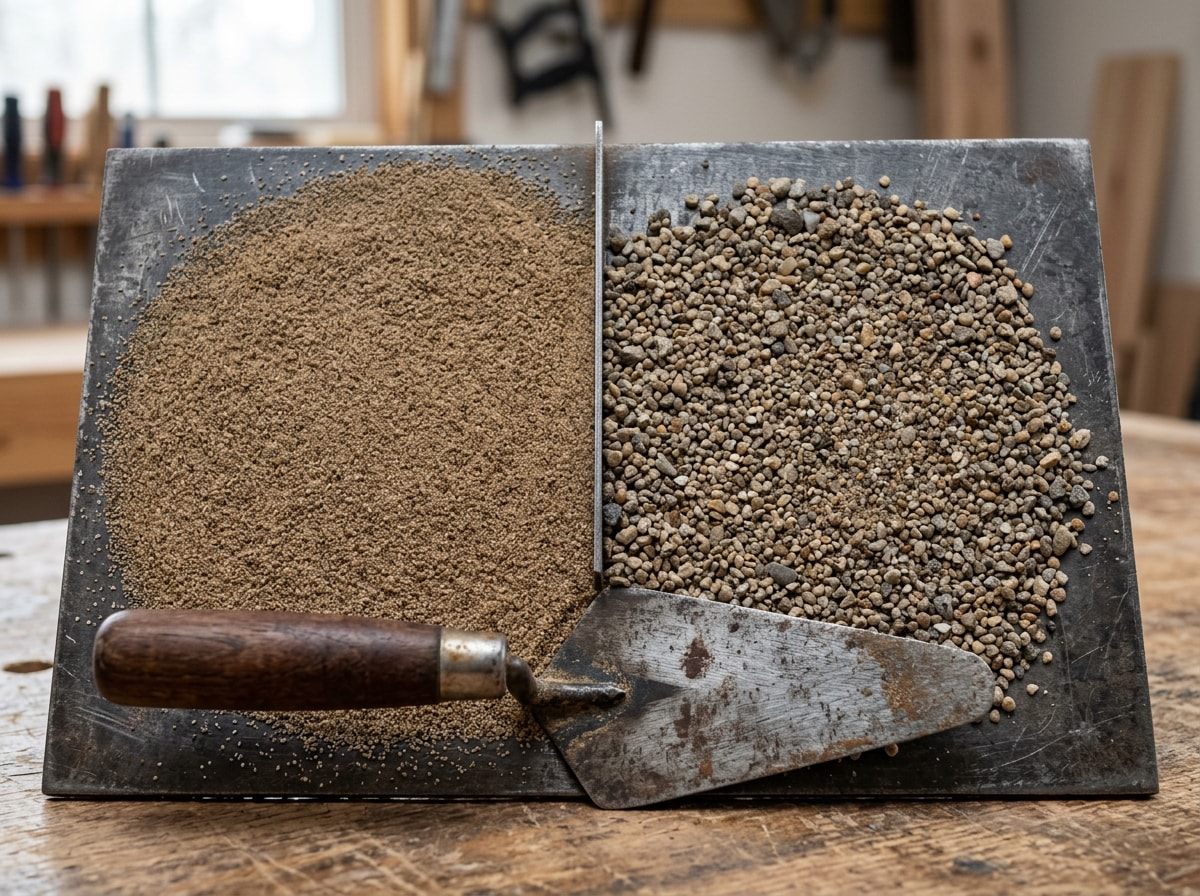
- Mason sand is fine and screened, for mortar, paver bedding and leveling.
- Concrete sand is coarse and washed, graded for structural concrete and mortar.
- Fill sand is utility grade, for backfill, pipe bedding and grading.
- Playground and white sand are decorative and non-structural.
One mistake shows up constantly on the island: native dune sand sitting on the lot is not a substitute for graded mason or concrete sand. It is poorly graded, often salty, and unpredictable in a mix. Concrete sand meets a published gradation, and inspectors can ask about it on permitted work.
Bagged sand is fine for a repair and expensive for anything else. A cubic yard of damp mason sand runs roughly 2,400 to 2,900 pounds, which is about fifty 50 pound bags. If your quantity crosses one yard, bulk delivery almost always wins on price and on your back.
How Much Material Do I Need?
Start with volume. Multiply area in square feet by depth in feet, then divide by 27 for cubic yards. Most aggregate runs roughly 1.2 to 1.5 tons per cubic yard. Add about 20% overage on orders under 5 tons and about 10% above that. One yard spreads roughly 100 to 160 square feet at 2 to 3 inches.
For masonry, these planning numbers keep the order close:
| Item | Planning figure | Basis |
|---|---|---|
| 8x8x16 CMU per 100 sq ft of wall | about 113 blocks | 3/8 inch joints, no waste factor |
| Mortar | roughly one 80 lb bag per 25 to 30 blocks | premixed mortar, standard joints |
| Grout, fully grouted 8 inch wall | about 1 cubic yard per 100 sq ft | assumes roughly 45% void in a two-core unit |
| Rebar | one vertical per grouted cell | schedule set by your engineer or code |
Those grout and mortar figures are arithmetic from stated assumptions, not a substitute for a submittal. Verify against your unit's actual net area and your approved drawings.
How Deep Should Stone Be?
Plan about 3 inches for decorative coverage and pathways so stone does not sink into sandy soil. Use 4 to 6 inches in drainage channels and erosion-control areas to handle summer storm volume.
Compacted base under pavers or a slab is a different calculation: typically 4 to 6 inches of crusher run placed in lifts and compacted.
Decorative depth is about appearance. Base depth is about load. Thin applications fail on a barrier island because loose sand swallows the stone, so separate the layers with geotextile fabric.
Getting that subgrade right is the whole job on sand. See site preparation and grading for how we prep island lots, or paver patio installation for finished base sections.
Delivery, Truck Sizes and Lead Times on a Barrier Island
Ordering is simple: pick the material, set the quantity, choose a date and window, and expect a confirmation call before the truck rolls. Access is the part that goes wrong.
| Truck | Typical use | Island limitation |
|---|---|---|
| Single-axle dump | Small residential drops, tight lots | Highest cost per ton |
| Tri-axle dump | Large base and sand loads | Needs turnaround room and firm ground |
| Flatbed with boom or piggyback forklift | Palletized block and bagged goods | Needs a level, firm set-down area |
Tailgate spreading means the driver eases forward while dumping to string material out. Drivers do not hand-spread or wheelbarrow.
Before the truck arrives:
- Mark one firm staging surface off the soft shoulder.
- Lay a tarp at the drop point to protect the drive and simplify cleanup.
- Clear low limbs and overhead lines on the approach.
- Confirm gate widths and any lease or association access rules.
Most bulk orders carry a minimum in the range of a few tons, with lead times commonly around two business days. Order earlier during peak building season and well ahead of named-storm activity, when yards and trucks tighten up fast. When you are ready to price a load with the work attached, get a free estimate and we will spec the materials with the build.
Why Pensacola Beach Salt, Sand and Wind Change the Order
Four conditions drive material selection here: salt spray and UV, loose shifting barrier-island sand, storm runoff over a high water table, and a narrow calm-weather window.
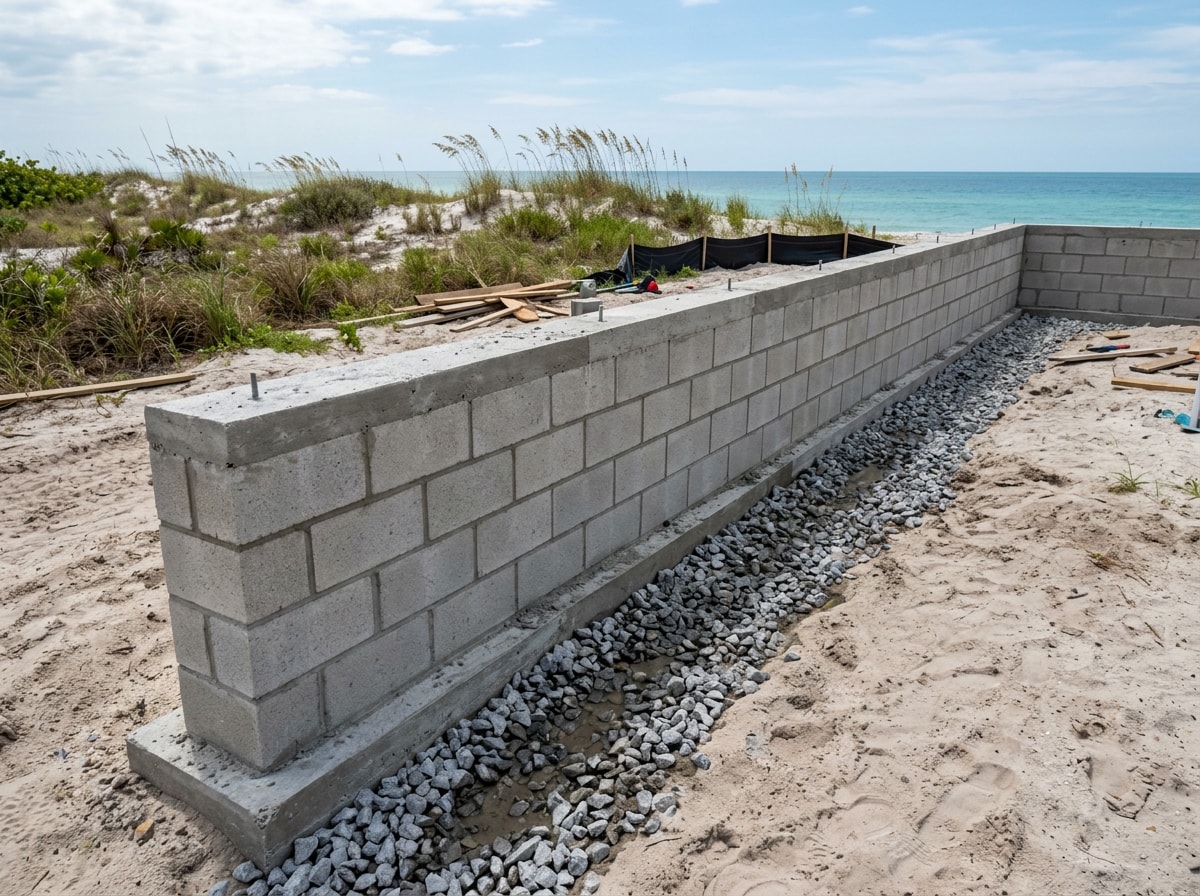
Salt changes the mix. Coastal masonry favors Type S mortar with coarse grout and fully grouted, reinforced cells, because chloride exposure attacks under-consolidated grout and poorly covered rebar far faster than it does inland. Adequate grout cover around steel does more for corrosion resistance than any admixture.
Santa Rosa Island also sits in Florida's high-wind and wind-borne-debris design region, which pushes designs toward reinforced, grouted CMU with a tighter rebar schedule. Treat that as general guidance. The binding requirement comes from the Florida Building Code and your local building department.
A typical beachside stem wall order reflects all of it: #57 stone under the footing for drainage, washed concrete sand for the mix, and coarse grout for filled cells. That is the same material stack behind our concrete foundation and footer installation work, and you can see finished examples on our projects page.
FAQ
What bulk materials do Pensacola Beach homeowners and contractors order most?
Coarse angular aggregate for load bearing and drainage, graded mason or concrete sand for mortar and bedding, CMU and specialty block for walls, and blended soil where vegetation has to grow. Pick base material by the job it performs under load, not by how it looks.
Can I buy concrete block and sand on Pensacola Beach itself?
Not in any real volume. Island retail is limited, so block, mortar, sand and stone come from mainland yards in Pensacola and Gulf Breeze and cross the bridge by truck. Budget for that zone charge.
What is the difference between mortar mix, mason mix and concrete mix?
Mortar and mason mix bond masonry units and are not structural on their own. Concrete mix contains coarse aggregate and carries load. Grout is a flowable, high-slump mix made specifically to fill reinforced cells around rebar. They are not interchangeable.
Do I need a permit or approval before scheduling a delivery?
Often, yes. Driveway changes, visible exterior work and structural masonry usually trigger review through Escambia County Building Services, and island leaseholds add their own layer. Work seaward of the coastal construction control line needs state review, since a Florida DEP CCCL permit is required for construction and excavation activities in that jurisdiction unless an exemption applies. Confirm with the authority having jurisdiction before you book a truck.
What time of year is best for masonry work and deliveries here?
Drier fall, winter and spring windows are easier than peak hurricane season. Timing matters more on masonry than on a gravel drop, because mortar and grout cure poorly in driving rain, and high tides plus heavy rain can complicate a delivery date.
How do I plan drainage and erosion control near the coast?
Use washed, dense stone where salt exposure is constant and coarser drain rock where water must move fast. Size and depth both matter, since thin layers wash out. Lay separation fabric over sand and grade so runoff moves away from footings.
How much does a cubic yard of sand or stone cover?
Roughly 100 square feet at 3 inches, or about 160 square feet at 2 inches, before compaction. Stone is usually sold by the ton, so convert using about 1.2 to 1.5 tons per cubic yard and confirm the yard's own density figure.
---
Written by the licensed concrete, masonry and excavation crew at Gulf Breeze Concrete Services, serving Pensacola Beach, Gulf Breeze, Navarre and Milton. We spec and place block, grout, sand and base stone on barrier-island jobs year round. Need a material list and a number for your project? Get a free estimate.